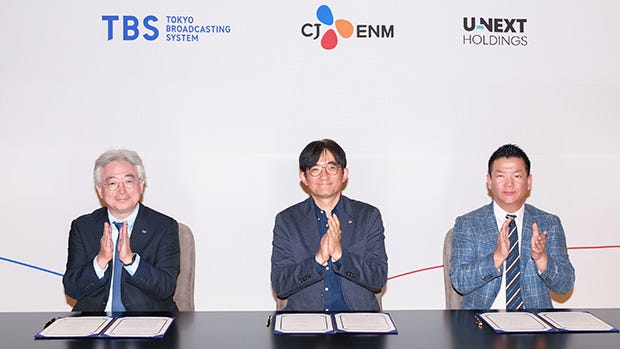
CJ ENM, TBS and U-Next have launched a joint venture called StudioMonowa. The press release is doing what press releases do. Three CEOs lined up for the photo. Phrases like “trinity” and “groundbreaking content.” A name built from the Japanese words for story and harmony.
Underneath the ceremony, the structure is more interesting than the language.
CJ ENM brings the K-drama production system. TBS brings Japanese IP discovery and a broadcaster’s catalogue. U-Next brings the streaming rail inside Japan. The official framing describes a life-time-value-based (LTV) model running from original IP discovery and investment through drama production, global distribution, secondary works and spin-off businesses (CJ ENM release, 1 May 2026, via C21 Media).
That sentence is the whole signal. Premium Asian drama is being rebuilt from a one-off commission market into an upstream IP architecture, and the people making the move are the region’s most market-tested players.
If you are a producer or development executive in Australia, India or Southeast Asia, the question StudioMonowa raises about your own slate is not whether to copy the structure. It is whether your current rights and partnership posture is still built for the market you are actually in.
What is actually being built
StudioMonowa is not a co-production shop. The role split makes that clear.
CJ ENM leads content planning and the production system. That is the export-disciplined K-drama machine, the one that has spent the last decade learning how to make shows that travel without losing local specificity.
TBS supplies original IP discovery inside Japan and runs the IP-side businesses and channel releases. That is access to Japan’s deep catalogue of manga, novel and broadcaster-originated material, plus the institutional weight to clear and develop it. U-Next handles platform supply and distribution as the primary home.
Three companies. Three different positions on the value chain. One vehicle designed to sit upstream of all of them.
The LTV framing is what separates this from the usual deal language. A normal commission ends at delivery and a few licensing windows. An LTV model is built to keep extracting value from the same IP across remakes, sequels, spin-offs, format sales, merchandising, overseas licensing and platform exclusivity windows, with the studio holding the architecture rather than the buyer.
I think now that is a meaningful reorientation for premium Asian drama, which has historically been packaged for export sale rather than retained for compounding exploitation.
CJ ENM has been building toward this for years through Studio Dragon and its expansion into US and global production. StudioMonowa applies the same logic to a Korea-Japan corridor and bakes it in from day one.
Why this combination, and why now
Korea has the global packaging discipline. Eight or nine years of consistent international hits have produced a production system that knows how to design for travel without flattening the work. Buyers everywhere now read K-drama as a category, not as foreign content.
Japan has the IP depth. Manga, light novels, anime adjacencies and broadcaster-originated formats give Japanese content a reservoir of source material that Korea, for all its production strength, has never had at the same scale.
The export logic of those two assets used to be linear. Korea sold finished drama to global buyers. Japan licensed manga and anime IP outwards, often into Hollywood adaptations that Japanese rights-holders did not control.
StudioMonowa rewires that relationship. Japanese IP gets developed inside a Korean-run production system, distributed first through a Japanese platform, and engineered for global travel from the start.
For U-Next specifically, the upside is structural. The Japanese streaming market is a contested space where local platforms have to differentiate against Netflix, Prime Video and Disney+. Sitting at the source of original IP development, with first-window status on what gets made, is a stronger position than buying finished hits at auction with everyone else.
It is also a more defensible competitive position than discount pricing or library volume, both of which the global majors can match or beat.
Where this is likely to strain
The execution risk sits in creative alignment.
Korean drama development is structured, deadline-driven and globally calibrated. Japanese drama and IP culture is more idiosyncratic, often broadcaster-led, and more comfortable with domestic specificity.
Forcing the two into a single development pipeline produces one of two outcomes. Either the Korean system wins and Japanese IP gets globalised at the cost of what made the source material distinctive, or the Japanese specificity holds and the production system has to absorb work that travels less cleanly than the K-drama benchmark.
Either is recoverable. Both are common in studio JVs. The risk worth flagging is the third path, where the venture splits the difference and produces drama that feels engineered rather than authored. That outcome is the one most likely to satisfy a deck and disappoint an audience.
The operator implication
For producers and development executives outside this JV, the question is not whether StudioMonowa will succeed. The question is what its existence says about how premium drama in this region is going to be built and bought from here.
The honest read is that the most strategically serious players in Asian content are no longer treating drama as a commission-to-export business. They are treating it as IP architecture. That changes how every project around them gets valued.
If you are developing a project in Australia, India or Southeast Asia and your rights strategy is still organised around the first-window deal, with secondary works, format rights and spin-off pathways treated as future upside to figure out later, you are pricing yourself for a market that is being rebuilt above your head.
The buyer you most want to attract is no longer thinking in single-window terms. They are thinking about what the project is worth across a decade.
That has practical consequences at development stage, not at exploitation stage.
It changes which rights you retain when you accept early development money. It changes how much you concede in a first-look or format option. It changes what attachments you build in early to keep the project legible as a multi-cycle property rather than a single show. It changes how you write the bible, because a bible that anticipates spin-offs and adaptations reads differently from one that ends at season one.
The question is no longer only who commissions this. The question is who controls the IP pathway after the first season, and whether the deal structure you signed eighteen months earlier still lets you participate in the answer.
StudioMonowa is one signal. There will be more. The producers who do best in the next cycle will be the ones who stop selling their projects as if the buyer is still thinking in one-window terms.
If you are working through a packaging, rights, or buyer-fit problem on a live project and want a sharper read on it, send a short note describing the situation to adi.tiwary08@gmail.com. I take a small number of these each quarter.