TL;DR: Five words, moat, cultural moment, platform-native, cadence, and tentpole, are doing serious damage in screen industry pitch decks. Not because they are wrong. Because they are being used as conclusions when they are actually unanswered questions. This piece names the failure mode, shows what it looks like in practice with a before/after rewrite for each, and ends with a one-page audit table you can run on any deck in under ten minutes.
Picture the deck. You are three slides in. The project sounds genuinely interesting. Then the language starts.
“This is a cultural moment.”
“The IP has a natural moat.”
“The format is platform-native.”
“We have a strong content cadence.”
“This is our tentpole.”
Nobody in the room flinches. Nobody asks what any of it means. The presenter moves on. The deck advances. The meeting ends with “we’ll be in touch.”
And everyone goes back to their desk having learned nothing about whether the project is actually good.
This is not a communication problem. It is a thinking problem wearing the costume of communication.
How It Happened
Screen industry strategy vocabulary has always borrowed from finance, tech, and consulting. That is not inherently bad. The problem is what happens when borrowed language gets passed around long enough that people forget what it was originally describing.
“Moat” is a Warren Buffett word. It means a structural, durable competitive advantage that prevents competitors from taking your market position. Switching costs. Network effects. Cost advantages that compound. It is a precise concept with a testable definition.
By the time it reaches a pitch deck for an unscripted format with one series order, it means: we think this is good.
The word has not changed. The thinking behind it has dissolved.
“Tentpole” has a specific lineage too. It comes from theatrical film distribution. A tentpole title, a major studio release designed to carry a seasonal release calendar and justify surrounding marketing spend, earns that label by hitting a financial threshold most projects never approach.
When a producer calls their six-part drama a tentpole in a pitch to a regional broadcaster, they are not making a financial argument. They are performing ambition.
The audience on the other side of the table knows this. They smile and move on.
This is the vocabulary inflation problem in plain terms: words that once meant something specific are now functioning as polish. And polish, applied thickly enough, obscures exactly the thinking the room needs to see.
The Five Offenders. In Order of Damage Done.
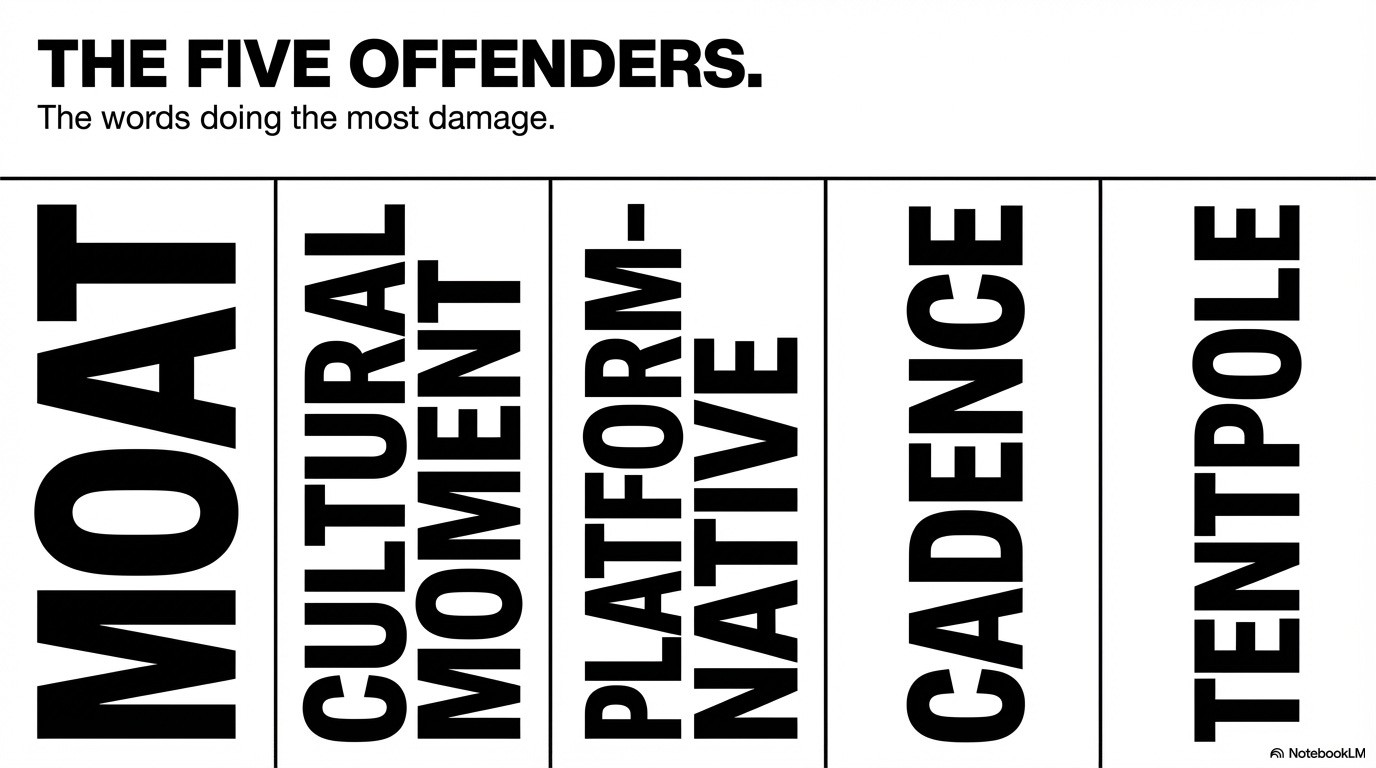
1. Moat
What It Is Supposed To Mean
A structural, durable advantage that is hard to replicate, by a specific competitor, over a specific time horizon, at a specific cost.
What It Usually Means In A Screen Deck
We are good at this. We got here first. We hope nobody copies us.
Why It Does Damage
It closes down the question it should be opening. The moment you write “moat” in a deck, the reader stops asking: what exactly protects this? For how long? Under what conditions does the protection erode? The word answers questions the presenter has not actually answered.
Before
“The brand has a natural moat in the lifestyle space. Competitors would struggle to replicate the authenticity and community trust we have built.”
After
“The brand has 340,000 paying subscribers who average 14 months before churning. The primary reason cited for staying is access to the founder’s weekly voice note. That access is contractually exclusive to us for 36 months. A competitor could build audience. They cannot license this specific relationship.”
The after version is longer. It is also the only version that tells you whether the advantage is real.
2. Cultural Moment
What It Is Supposed To Mean
There is a specific, time-sensitive alignment between this project and a shift in audience attention, cultural conversation, or social behaviour that creates a narrow commissioning window.
What It Usually Means In A Screen Deck
People are interested in this topic right now. We have noticed.
Why It Does Damage
“Cultural moment” is a commissioning argument with no commissioning logic attached. It says: act now, the window is closing. But it never says how wide the window is, who is inside it, or what happens to the project’s value proposition when the moment passes. It borrows urgency without supplying evidence.
It is also, quietly, a trap for the presenter. The moment you invoke a cultural moment, you have made your project’s relevance contingent on external timing you do not control.
If the commission takes 18 to 24 months, which it usually does, you have just dated your own pitch.
Before
“This project speaks directly to the cultural moment around female ambition and workplace identity. The conversation is happening everywhere right now.”
After
“The workplace identity conversation has produced three consecutive years of audience growth in the drama space, peaking in the 28 to 44 female demographic across streaming and BVOD. This project is not chasing a moment. It is designed for an audience whose interest has structural durability. Here is how the format survives a five-year window.”
The after version is not less ambitious. It is more useful. It tells the buyer whether to feel reassured or nervous about timing. That is the information the room actually needs.
3. Platform-Native
What It Is Supposed To Mean
The format, interaction model, and distribution logic of this project are designed specifically for the technical and behavioural constraints of a particular platform. The content would not work, or would work differently, on any other platform.
What It Usually Means In A Screen Deck
It is vertical. Or short. Or we are pitching it to a streaming service and wanted to say something platform-y.
Why It Does Damage
This one is particularly insidious because it sounds like precision. “Platform-native” has the texture of a strategic choice. It implies the presenter has done the format design work. Usually they have not. They have made it 9:16 and called it a day.
The actual platform-native question is harder: what does this platform’s recommendation algorithm reward, and how does the format design exploit that reward structure? What does the monetisation mechanic require from the content? What does the platform’s existing audience come to it for, and does this project give them more of that or something deliberately adjacent?
When “platform-native” answers those questions, it earns its place in the deck. It almost never does.
Before
“The series is fully platform-native, designed for mobile-first consumption with a vertical format and short episode structure optimised for the TikTok and Instagram audience.”
After
“Each episode is 90 seconds, structured around a single unresolved question answered in the following episode. The cliffhanger mechanic is designed for TikTok’s loop behaviour: a viewer who watches to the end is algorithmically served the next episode. Episode one drives Episode two. We have tested this structure with three short-run series. Average loop rate: 34%. Average episode-two pickup from episode-one completion: 61%.”
The after version describes a format logic, not a format choice. That is the difference.
4. Cadence
What It Is Supposed To Mean
A specific, considered release schedule, designed around audience habit formation, platform algorithm behaviour, and production reality, with a clear logic for how the timing of content drops serves the commercial objective.
What It Usually Means In A Screen Deck
We plan to post regularly. Maybe.
Why It Does Damage
“Cadence” is the inflated process word in this list. The others overclaim on outcomes. Cadence underclaims while sounding disciplined. It is the vocabulary of someone who wants to appear organised without committing to a schedule.
The damage it does is specific. It replaces a concrete production and release commitment with the impression of one. In a pitch deck, it is almost always standing in for a set of unanswered questions: how often, on what platform, triggered by what audience behaviour data, and what happens to the cadence when production runs late or budget compresses? Nobody ever specifies. The word absorbs the question.
There is a second problem. Cadence implies the presenter has thought about audience habit. Habit formation in content requires a consistent interval, a predictable format, and a reason for the audience to return on schedule. “We have a strong content cadence” says none of that. It says: we are aware that publishing regularly is a good idea.
Before
“The series is designed with a cadence that builds audience habit and platform loyalty over the course of the season.”
After
“Episodes drop weekly on Thursdays at 6pm AEST. The schedule is fixed for the first six episodes regardless of performance. If episode four hits above a 40% completion rate, we accelerate the final two episodes to a twice-weekly drop for the close. Here is what that looks like on the release calendar, and here is the production contingency if we are two weeks behind in post.”
The after version describes a release logic with a performance trigger and a named contingency. That is what cadence is supposed to mean when someone uses it in a room with buyers. It almost never does.
5. Tentpole
What It Is Supposed To Mean
A title that anchors a slate, absorbs a disproportionate share of marketing investment, and justifies surrounding programming by driving audience acquisition that benefits the whole schedule.
What It Usually Means In A Screen Deck
This is our most important project. We want you to treat it like it is.
Why It Does Damage
Of the five words, tentpole does the most specific financial damage because it carries an implicit ask. When a presenter calls their project a tentpole, they are signalling: this warrants tentpole-level marketing, tentpole-level priority, tentpole-level commitment. They are making a claim about what the project deserves before demonstrating what the project can deliver.
The buyers and commissioners who hear it most often have learned to translate it automatically: they want more money. And they move on.
The actual tentpole argument is an audience economics argument. It requires: projected audience acquisition numbers, an explanation of how this title drives retention or churn reduction across the broader slate, and a realistic assessment of the marketing investment required to achieve those numbers. Most projects called tentpoles in pitch decks cannot supply any of those three things.
Before
“Season two is designed as a tentpole for the network’s summer schedule. It has the scale, the cast, and the cultural presence to anchor the quarter.”
After
“Season one averaged 1.2 million consolidated viewers across its run. Post-launch social tracking showed a 22% uplift in new subscriber trials during the broadcast window. We are projecting Season two to deliver a 30% audience increase on that base given cast expansion and the marketing infrastructure we are proposing. Here is what the summer schedule looks like if that projection holds, and here is what it looks like if it misses by 20%.”
The after version is a business argument. The before version is a compliment the project is paying itself.
The Underlying Pattern
Read those five “before” sentences back to back.
“The brand has a natural moat in the lifestyle space.”
“This project speaks directly to the cultural moment.”
“The series is fully platform-native.”
“The series is designed with a cadence that builds audience habit.”
“Season two is designed as a tentpole for the network’s summer schedule.”
They could appear in the same deck. They probably have. They feel like strategy. They have the cadence, and yes, that word is doing the same thing here, of someone who knows what they are talking about.
They are, collectively, five unanswered questions dressed in a suit.
The pattern underneath all five is the same.
Each word names a desirable outcome without describing the mechanism that produces it.
Moat without switching costs.
Cultural moment without audience durability.
Platform-native without format logic.
Cadence without a schedule or a contingency.
Tentpole without audience economics.
Polished language standing in for precise thinking.
The AI-era writing observation applies here too, and I want to be precise about it. The problem is not AI. AI did not invent sloppy strategy vocabulary.
Screen industry decks were full of this language long before a language model could generate it. What AI has done is lower the production cost of fluency.
You can now produce a 40-slide deck that reads like a McKinsey brief in an afternoon, without the underlying analysis a McKinsey brief would require.
The gap between how a deck sounds and what it actually contains has never been wider or easier to create.
That gap is the problem. The vocabulary is the symptom.
The One-Sentence Test
Ban the word.
If you cannot explain the advantage, the timing, the format logic, the release plan, or the financial role of your project in plain English without using moat, cultural moment, platform-native, cadence, or tentpole, you have not finished the thinking.
You have just finished the slide.
Run any deck through this table before it goes into a room.
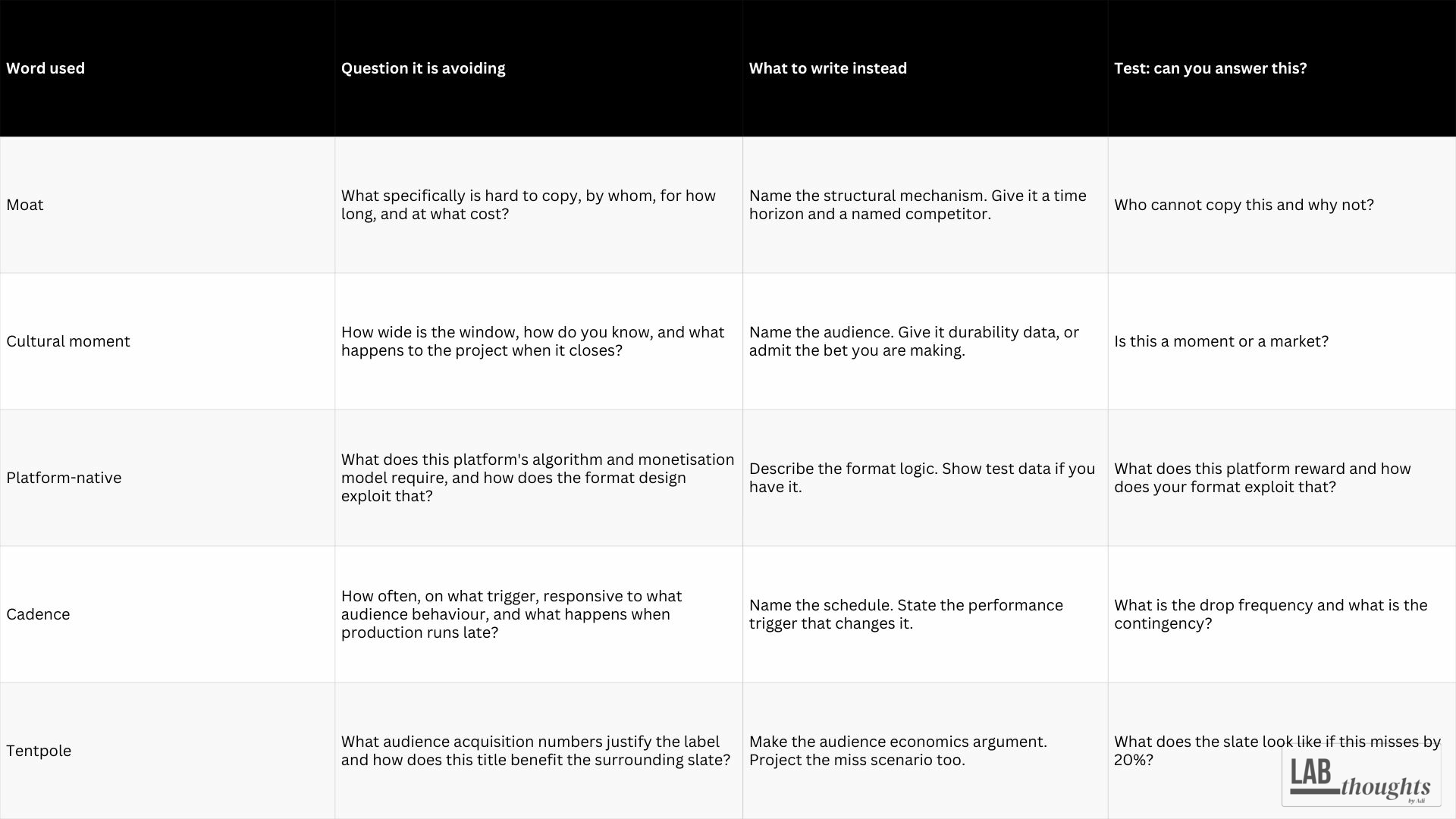
The deck that survives this table is shorter. It is also the one that gets a second meeting.
A Note on Who This Is For
If you are on the buying side of these conversations, you already know this. You have been translating inflated vocabulary back into real questions for years. The table above is the translation guide you have been running in your head.
If you are on the presenting side, the argument is simpler: the people in that room are not impressed by the vocabulary. They are waiting for the moment it stops.
Give them that moment earlier. The deck will be better for it.
A question for the room, and I mean that literally: what is the word you keep seeing in decks right now that is doing the most camouflage duty?
The ones above are mine. I suspect the list is longer.
Reply or drop it in the comments. If enough of the same word keeps coming up, that is probably the next piece.
If this raised a question about a project you are working on, email me at adi.tiwary08@gmail.com. I work with producers, development teams, and strategists on projects that need sharper positioning, stronger buyer legibility, or clearer rights strategy. The best place to start is a Project Audit.