In April 2026, after Iron Lung had broken out theatrically, Mark Fischbach (known online as Markiplier) ran into a problem that should interest anyone building creator-led screen packages in APAC.
He had financed the film himself. According to The Numbers, it cost a reported $3 million and grossed roughly $51 million worldwide by early May 2026. He had more than 38 million YouTube subscribers. He controlled the film and its release path. The film was self-released by Markiplier in North America on 30 January 2026, with international releases handled through other arrangements. The obvious next move seemed simple: sell the film directly to the audience on the platform that had built that audience.
It was not simple.
IndieWire reported that after what Markiplier described as an arduous legal process, the negotiation escalated as far as YouTube CEO Neal Mohan before YouTube agreed to serve as the exclusive digital home for Iron Lung. That reads as an exception for one film from an outlier creator.
The point is not that Markiplier bypassed the distribution system. The point is that even Markiplier, with the conditions stacked unusually in his favour, had to reconstruct distribution-equivalent functions before YouTube made an exception. He hired theatrical bookers. He bought a 100-disc DVD printer rather than absorb the cost and timelines of third-party manufacturing. He is now positioning himself to help other independent filmmakers access YouTube distribution without an intermediary.
He is not removing the distribution function. He is replacing the middleman with himself.
Heres the Lab’s Thoughts on this
The Markiplier story is being read across the creator economy as proof that audience-led creators can self-distribute. The reading is half-true and operationally dangerous. The fuller picture is structural.
YouTube can create audience leverage… but it does not automatically convert that leverage into distribution control.
For APAC operators evaluating creator-led scripted pitches, the audience is a discovery asset, not a route to market. Treating audience leverage as a rights argument prices the creator like a distributor. They are usually a discovery channel that converts to talent or to a packaged-IP licensor on platform-favourable terms.
Why the platform sits where it sits
Aggregators are not gatekeepers in the lazy sense. They handle real complexity. Rights clearances across territories, metadata to specifications, technical standards across formats, transaction infrastructure, and dispute handling.
For independent films, the practical route into transactional platforms like YouTube Movies typically runs through aggregators, distributors, or studio partners. That is not a public YouTube policy… it is a structural reality of how the rights and transaction layer of the value chain has been built.
When asked about making YouTube a destination where films are discovered and watched in full, Mohan told IndieWire that the truest thing the platform can do is continue to invest in discovery, and that most of YouTube’s investment really goes towards that. That is consistent with how the platform has actually operated for years.
YouTube is structurally stronger as a discovery, creator-monetisation, and audience infrastructure layer than as a self-serve feature film distributor for individual creators. The Markiplier exception is informative because it shows what the platform is willing to do, and at what cost, for an outlier. It also shows what most creators with audiences will not get.
The Kevin Smith brake
The natural temptation is to read Markiplier as proof of concept. Audience-led creator, self-finance, self-distribute. New model!!
But wait a minute…three decades ago, Kevin Smith became a Hollywood cult hero with Clerks, and some took the wrong lesson, believing they could skip film school and make a movie that would be acquired by a major distributor. The conditions that made Smith’s outcome possible were not portable. They were specific to a moment, a buyer ecosystem, a festival mechanic, and a person.
Markiplier’s conditions are similarly unportable. More than 38 million YouTube subscribers built over fifteen years. Capital independence sufficient to self-finance a $3 million horror film without external pressure. A genre native to YouTube culture, where Let’s Plays and indie horror have always travelled. A premise that had already lived for years as a cult video-game IP with a built-in core. A horror format that is one of the few things still pulling people to cinemas at scale. Almost none of those conditions exist for almost any other creator with an audience.
That does not make the story irrelevant. It makes the lesson structural, not tactical. A built-in audience converts to commercial outcomes under narrow conditions. The narrowness is the whole story.
Where this lands in APAC
For APAC operators, the test happens in pitch rooms.
Take India, where YouTube’s user base is among the largest in the world. Reuters, citing DataReportal, has reported around 500 million YouTube users in India. That makes India a strong test case for any creator-led audience argument.
Bhuvan Bam’s BB Ki Vines channel has more than 26 million subscribers. In 2021 he released Dhindora, a scripted eight-episode comedy-drama, on his own YouTube channel. Outlook India reported in July 2022 that it had become the first Indian limited series to clock half a billion views on YouTube. Audience leverage. Owned IP. Production capability through BBKV Productions. By the logic of the audience-as-distribution argument, reading, he was one of India’s strongest creator-to-scripted cases.
Then on 3 February 2026 it was reported that the second season of Dhindora would stream on Netflix, with production reported in 2026.
The pattern repeats across his catalogue. Taaza Khabar, his 2023 scripted debut, went to Disney+ Hotstar and returned for a second season in 2024. He is also part of The Revolutionaries, a period drama directed by Nikkhil Advani set to premiere on Amazon Prime Video in 2026.
One of India’s strongest creator-to-scripted cases routed his next moves through platform commissions. Not because he had to. Because the platforms offered something the audience leverage did not. Commissioning fees, scripted budgets, international reach, deliverables infrastructure, and a route to market that did not depend on him underwriting the whole stack himself.
The audience proof was real. It set the terms of the platform deal. It did not replace the platform deal.
The Australian gap
Australia is the least structurally mature creator-to-scripted market among the examples in this piece, and the underdevelopment is informative rather than incidental.
The closest local equivalent to a creator-to-scripted pipeline is Aunty Donna, the Melbourne absurdist comedy troupe. They built an audience through their YouTube channel and live touring, made their TV debut with Aunty Donna’s Big Ol’ House of Fun on Netflix in November 2020, then followed with Aunty Donna’s Coffee Cafe on ABC in 2023. The sequencing is the signal. As they acknowledged in an SBS interview in August 2025, the global streamer gave them their own show before any local TV networks did. The local commission followed the international validation. The audience proof alone did not unlock a local commission. It unlocked an international one, which then opened the local door.
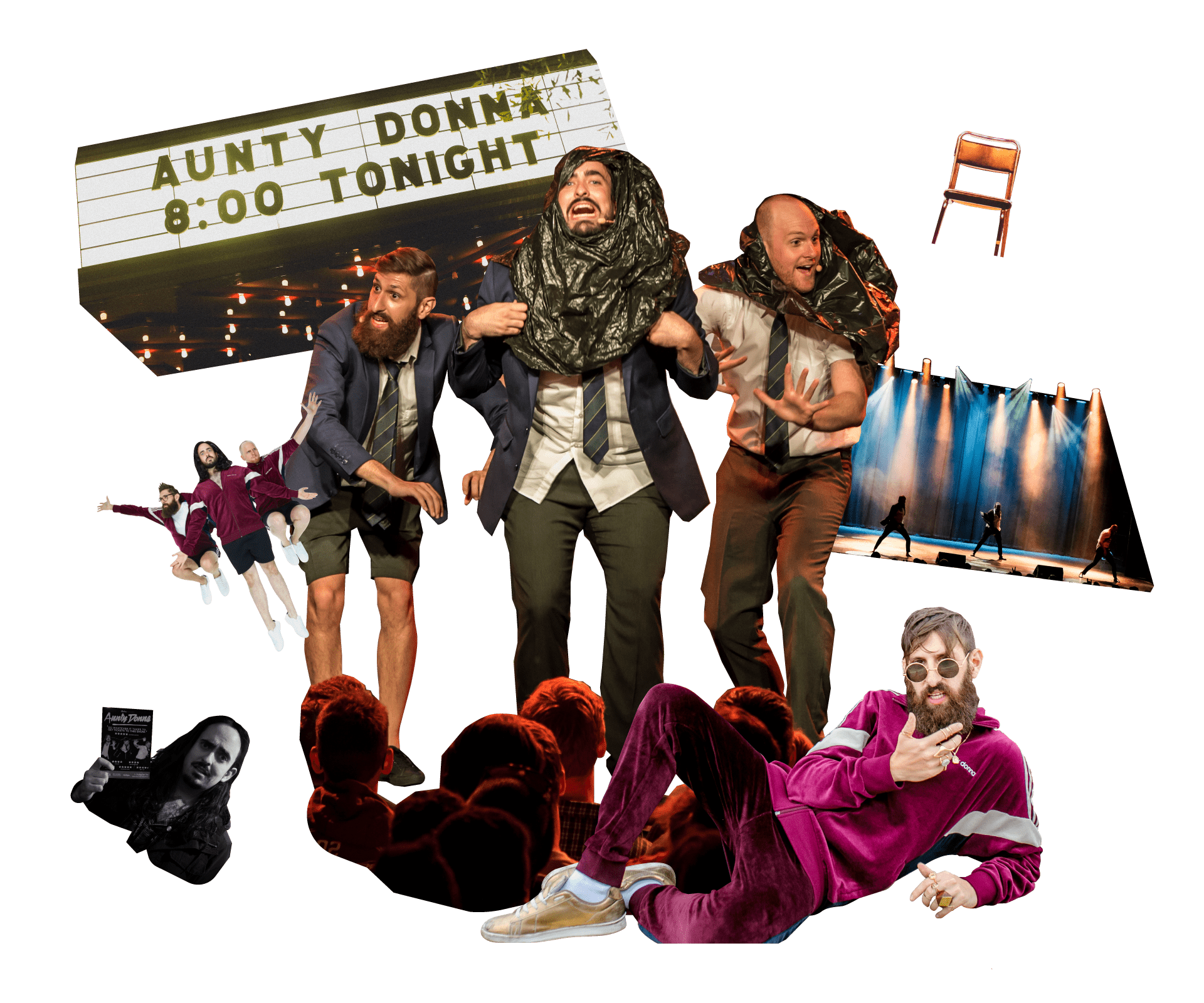
The trajectory since is the closest thing Australia has to a creator-owned distribution play. In 2024 the group produced Descent, a five-part comedy series for their Grouse House YouTube channel, with principal production funding from Screen Australia in association with VicScreen. In August 2025 The Guardian reported that they were trialling Grouse House as a subscription streaming service modelled on the US comedy SVOD Dropout, with a hard launch targeted for early 2026.
That is the most credible creator-led distribution surface in the Australian market right now, and it is being built by a troupe with two prior platform commissions, screen agency production funding, and an explicit US reference model.
In my opinion, none of those conditions are widely replicable across the Australian creator base. The broader Australian creator-to-scripted pathway is structurally underdeveloped, and the underdevelopment shows up at three levels.
First, audience scale.
Aunty Donna’s main YouTube channel sits at around 640,000 subscribers, where Bam’s is at more than 26 million and Markiplier’s at more than 38 million.
Australian creator audiences usually compound into smaller absolute subscriber bases than US or Indian equivalents because the domestic population base is smaller and export has to do more work earlier in the trajectory.
Second, funding structure.
Australian screen funding is organised around traditional production company packaging. Screen Australia, the state agencies, and the broadcasters can and do back creator-aligned work, but the entry path usually routes through a traditional production company or co-production structure rather than a creator who has built an audience independently. The Aunty Donna pathway for Descent ran through Haven’t You Done Well Productions and public funding, not through their YouTube channel as a standalone commercial entity.
Third, theatrical compression.
The Markiplier theatrical path is harder to replicate in Australia because the local theatrical market is smaller, more concentrated, and less forgiving for independent genre projects scaling without studio, agency, or major distributor support.
For Australian development executives and producers, the operator consequence is specific. Creator-led scripted pitches should be evaluated on the realistic route to platform commission, not on a self-distribution thesis.
The Markiplier path is even less portable here than it is in India or the US. The path that exists is the Aunty Donna path. Build audience. Route through an international streamer first. Follow with a local commission. Then, only then, consider creator-led distribution at the margins, and even then probably through a niche SVOD model rather than a self-distribution stack.
The microdrama wave is the platform-owned inverse
Microdrama platforms are being built on the opposite assumption from YouTube. They are deliberately built to own the rights, the audience relationship, and the transaction layer in one stack.
Lumikai’s reporting, cited in Indian business press, projects India’s microdrama market to reach around $4.5 billion by 2030, with the segment crossing $300 million, around 450 million downloads, and around 100 million monthly active users. Indian trade outlets reported in late April 2026 that Yash Raj Films is planning to invest around ₹150 crore in microdramas over the next few years, with content creation and a direct-to-consumer app, led by CEO Akshaye Widhani.
If the reported YRF push proceeds on those terms, the useful signal is that the studio entry is being imagined as a platform and content stack, not as a creator marketplace.
The Fox-Dhar Mann arrangement is the most useful comparison point, because it shows what a creator-led deal actually looks like inside this stack. Fox Entertainment signed a multiyear deal in January 2026 with Dhar Mann Studios for an initial slate of 40 narrative-driven vertical-video titles, debuting on Holywater’s My Drama app with worldwide distribution handled by Fox Entertainment Global. Fox had taken an equity stake in Holywater in late 2025. Through the partnership, Mann retains ownership and creative independence over his original content.
The deal sits between creator-owned production and studio-style distribution. It is not an open creator marketplace, but it is also not a simple work-for-hire commission. The creator gets ownership and creative autonomy. The platform stack handles the windowing, sales, and distribution mechanics that the creator’s audience alone cannot deliver at this scale.
Read at that grain, the deal supports the same operator point. Audience scale gives the creator real terms. The terms still route through a distribution stack. The stack is what makes the format work commercially.
Korea as the cleaner conceptual comparison
Korea is a cleaner conceptual comparison, not because every creator retains perfect IP control, but because webtoon platforms have built a mature IP-to-screen pipeline where audience proof, platform data, and adaptation rights are already part of the commercial grammar. The screen adaptation pays for the underlying IP. The creator’s audience is a credibility signal at the front of the chain, and the adaptation route is structured to convert audience proof into licensed long-form. That is the conversion APAC operators in other markets are usually looking for when they say “audience leverage.”
The pipeline depends on a webtoon ecosystem most APAC markets outside Korea do not have. It is therefore not a model most operators in India, Australia, or Southeast Asia can borrow whole. But it is the cleanest example of what creator audience leverage actually buys when the system around it is structured to convert it.
What changes for the development executives
For the development executive sitting across from a creator-led pitch where the audience leverage is being used as the rights argument, four moves are now operational.
Price the audience as a discovery asset, not a route to market. It reduces the marketing budget a comparable studio-led project would need. That is real value. It does not replace the rights, transaction, and pathway-to-audience layers that a working distribution structure has to cover. Those still need to be priced and structured separately.
Ask what the audience actually converts at. Engagement on a YouTube channel does not equal conversion to a paid scripted product. Bam’s free YouTube series did half a billion views. Dhindora season two went to Netflix because conversion to paid scripted work needed the commissioning fee, the international reach, and the deliverables infrastructure.
The conversion rate from free audience to paid scripted product is the number that matters, and it is almost never the headline subscriber figure.
Map the route to market the package is actually proposing. If it is “the creator’s audience plus a self-distribution thesis,” ask which distribution function is being absorbed and at what cost. Theatrical bookers, DVD pressing, rights clearance, metadata, territorial deliverables. Each function is real. None of them disappear because a creator has subscribers.
The Markiplier path absorbed all of them through personal cost, personal capital, and a CEO-level negotiation. That stack is not available to most creator-led pitches.
Place the platform you are dealing with on the discovery-versus-distribution axis. YouTube sits in discovery. Microdrama platforms are vertically integrated discovery, transaction, and rights stacks. SVOD platforms (Netflix India, Hotstar, Prime Video) are commissioning bodies with discovery layered on top. The same audience-led pitch will work very differently across each, because the platform’s structural appetite for rights, transactions, and pathway-to-audience differs at each layer.
The more useful question
The more useful question is not whether creators can self-distribute now. It is where in the value chain the platform you are dealing with is structurally willing or unwilling to let audience leverage convert into rights leverage, and what the second-best move looks like inside that constraint.
YouTube can create audience. It is not built to convert that audience into self-serve distribution control for the individual creator.
For APAC operators building creator-led packages on the assumption that audience leverage equals distribution leverage, this is reading the Markiplier story as if it were the whole story. The exception still required a CEO-level negotiation. The rule is the part to plan around.
If you are sitting with a version of this problem on a live project and want a clear outside read before more time goes into the wrong direction, send a short note describing the situation to adi.tiwary08@gmail.com. I take a small number of these each quarter.